Conditions & Exceptions
Both conditions and exceptions use the same set of rules. Exceptions are simply the logical opposite of conditions.
- When an exception is met, the action will not be performed on the message.
- When a condition is met, the action will be performed on the message.
The application first checks for exceptions. If no exceptions are met, it then evaluates the conditions. If the conditions are met, the action is executed on the message.
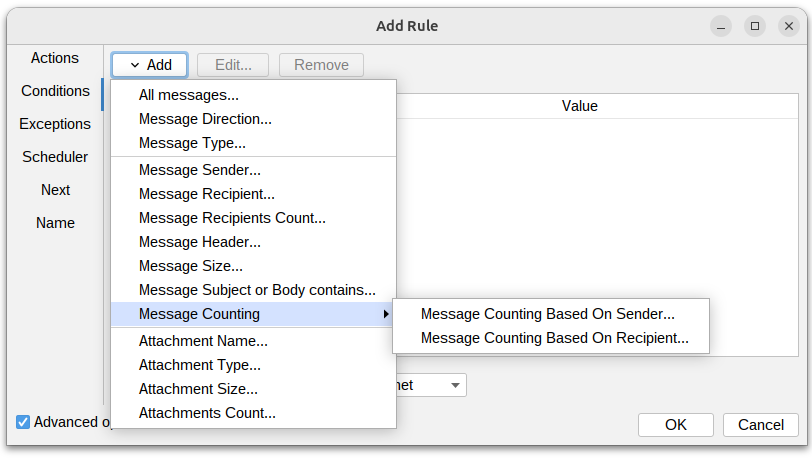
All messages
Matches all messages.
See All messages condition.
Message direction
Matches messages by their direction: incoming, outgoing, or internal.
See Message direction condition.
Message type
Matches the type of message: new, reply, forward.
See Message type condition.
Message sender
Matches the sender by: email address, user, group or domain.
See Message sender condition.
Message recipient
Matches the recipient by: email address, user, group or domain.
See Message recipient condition.
Message recipients count
Matches messages by the number of recipients.
See Message recipients count condition.
Message header
Matches text in message headers.
See Message header condition.
Message size
Matches messages by size.
See Message size condition.
Message subject or body contains
Matches when the subject or body has specific text.
See Message subject or body contains condition.
Message counting based on sender
Counts messages from a sender and matches by the count.
See Message counting based on sender condition.
Message counting based on recipient
Counts messages to a recipient and matches by the count.
See Message counting based on recipient condition.
Attachment name
Matches the attachment file name.
See Attachment name condition.
Attachment type
Matches the attachments by their content type.
See Attachment type condition.
Attachment size
Matches attachments by size.
See Attachment size condition.
Attachments count
Matches messages with a certain number of attachments.
See Attachments count condition.